Build Versus Reuse Without Renting Your Brand
A practical rule for deciding what to own, what to reuse, and when to upgrade from free-first content tooling.
You do not need to build every marketing tool from scratch.
That is a trap. It sounds principled, but it usually turns into a half-finished CMS, a brittle email sender, and a content calendar nobody uses.
You also should not put the most important part of your brand entirely on someone else's platform.
That is the other trap. It feels fast at the start, then the canonical article, subscriber relationship, search surface, design system, and learning loop all belong somewhere else.
The useful middle is simple:
Own the proof. Reuse the reach. Build or keep ownership over the artifacts that prove the brand: canonical pages, source files, subscriber data, analytics context, and reusable operating procedures. Reuse external tools for reach, delivery, editing, and automation when they remove a proven bottleneck.
This is the rule behind Vibegrow's publishing setup.
The point is not "build everything" or "never use Substack." The point is to know what job each tool is allowed to do.
The operating model
The three buckets
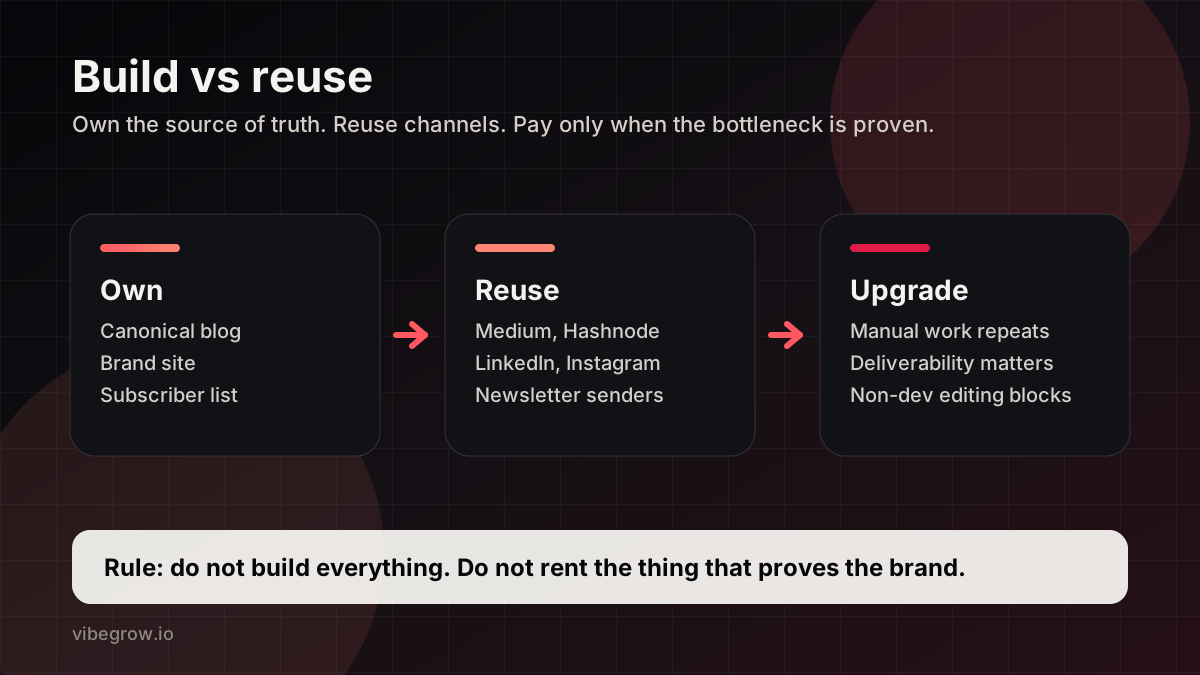
Every content decision belongs in one of three buckets.
| Bucket | What it means | Examples |
|---|---|---|
| Own | The artifact is part of your brand's durable memory | Website, subscriber list, design assets, reusable briefs, analytics context |
| Reuse | The tool extends reach or reduces work without owning the source of truth | Medium, Hashnode, LinkedIn, Instagram, communities, exportable senders |
| Upgrade | The paid or heavier tool fixes a repeated bottleneck | Newsletter deliverability, non-dev editing, workflow automation, analytics depth |
Most teams get into trouble when they confuse these.
Medium is useful for discovery. It is risky as the only home for your best thinking.
Substack or beehiiv can be useful for sending and growth loops. They should not be the only place your company knows what it believes.
Ghost or WordPress can be useful when editing and publishing are the bottleneck. They are unnecessary if the real problem is that nobody has written one useful article yet.
What Vibegrow owns first
Vibegrow owns the parts that make the brand compounding:
- The canonical article URL.
- The social image and brand assets.
- The newsletter archive.
- The subscriber capture and export path.
- A simple record of what earned replies, clicks, and subscribers.
That may sound like a lot, but it is intentionally plain. It is mostly pages, RSS, a form, and basic measurement.
The advantage is that every post becomes reusable context.
A founder can copy the pattern. A customer can see how the brand thinks before buying the product.
What Vibegrow reuses
Reuse is not a compromise. It is leverage.
Reuse is allowed when the job is clear External platforms should be treated as distribution, delivery, or workflow tools. They should not quietly become the only archive, only subscriber relationship, or only proof that the brand knows what it is doing.
Here is the current ladder.
| Need | Free-first move | Reuse path | Upgrade trigger |
|---|---|---|---|
| Publish article | Owned blog | Hashnode or Medium copy after publish | Non-dev editing blocks cadence |
| Send newsletter | Markdown issue plus subscriber export | Buttondown, Kit, beehiiv, Substack, Resend, or Postmark | Manual sending, templates, volume, or deliverability become painful |
| Reach founders | LinkedIn post and comments | Communities, partner newsletters, podcasts | A channel produces qualified replies or subscribers |
| Reach visual channels | Instagram carousel and reel script | Design templates, scheduling tools | Repeated visual production slows publishing |
| Measure learning | Simple notes and analytics | Analytics dashboards and UTM reporting | Attribution becomes too unclear to decide what to repeat |
The exact tools can change. The rule should not.
Start with the cheapest reliable path that keeps the brand's memory owned. Pay when the manual path has become the bottleneck, not before.
Why not Medium first?
Medium is fast. That is the argument for it.
But if the first serious Vibegrow article lived only on Medium, the proof would be weaker. We would be saying we help brands build their own growth system while renting our own core content surface.
Use Medium after the owned post exists:
- Publish a shortened or adapted version.
- Add an "originally published on Vibegrow" note.
- Link to the canonical article.
- Track whether the platform sends qualified clicks or replies.
That gives us reach without giving up the source of truth.
Why not Substack first?
Substack is good when the newsletter itself is the product or when built-in network effects matter more than owning the full site experience.
That is not the first bottleneck here.
Vibegrow's first bottleneck is sharper thinking, clearer positioning, and a repeatable content loop. A simple subscriber form, archived issue, CSV export, and unsubscribe link are enough until sending becomes painful.
If manual sending slows us down, we should upgrade. Until then, buying a sender does not make the article better.
Why not Ghost or WordPress first?
Ghost and WordPress can be the right answer when a team needs a richer editor, roles, plugins, membership features, or non-dev publishing.
That is not the current operating constraint.
Right now, the source lives close to the product. That makes the setup easier to maintain while the audience is still small.
If writing starts depending on non-dev contributors every week, add an editor. Until then, a heavier CMS mostly adds surface area.
The paid-later rule
Paid tools are not bad. Premature tools are bad.
Upgrade only after repeated evidence One annoying manual step is not enough. Upgrade when the same bottleneck repeats, when the cost of manual work is clearly higher than the tool cost, or when a channel proves it can create qualified demand.
Use this review before adding tooling:
- What exact job is failing?
- Did it fail more than once?
- Is the issue content quality, distribution, workflow, deliverability, or measurement?
- Can a free or exportable tool solve it without moving the source of truth?
- What will we stop doing if the paid tool does not improve the signal?
If you cannot answer those questions, do not buy the tool yet.
The copyable version
For another founder, the system can start this small:
- One owned article page.
- One newsletter signup form.
- One exported subscriber list.
- One email draft.
- One reuse checklist.
- One simple record of what worked.
That is enough to learn.
You can add Medium, Hashnode, LinkedIn, Instagram, Substack, Ghost, WordPress, or a paid sender later. Just keep the decision honest:
Copy the rule Own the artifact that proves the brand. Reuse the channel that expands the reach. Upgrade only when the bottleneck is real.