What a Useful Marketing Skill Actually Contains
A practical breakdown of the parts that turn a prompt into a reusable marketing skill your AI agent can run.
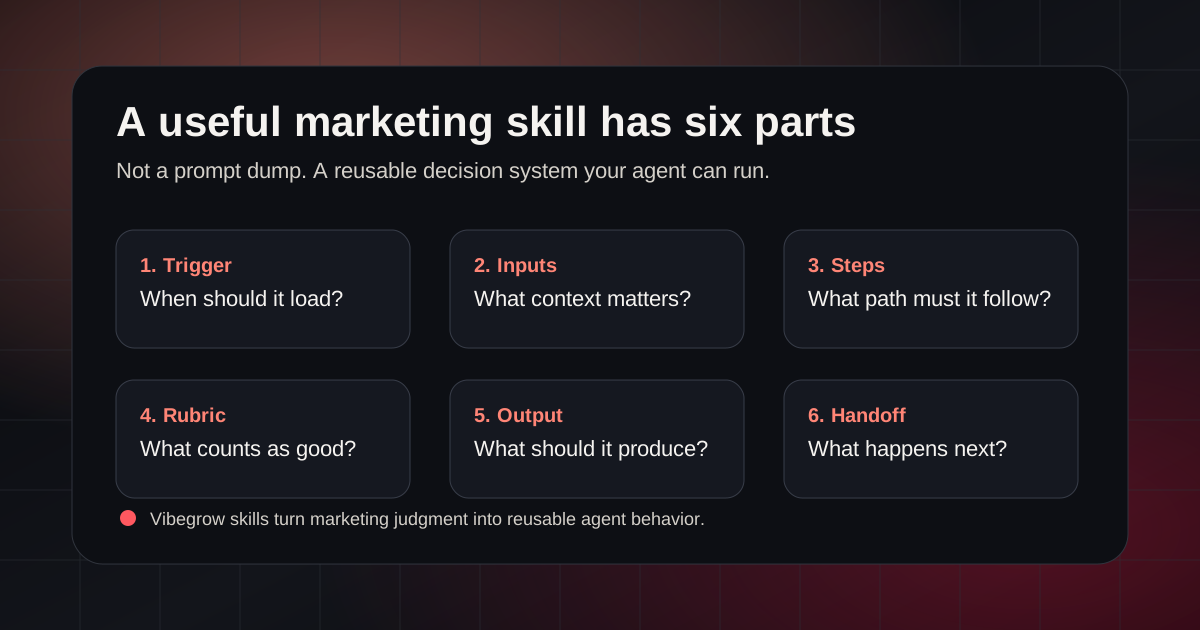
A prompt tells an AI agent what to do right now.
A skill tells the agent how to do the work well every time the job appears.
That difference matters for marketing because most bad AI marketing output is not caused by missing words. It is caused by missing judgment.
The agent writes a plausible headline but never checks the audience. It writes an email sequence but forgets the activation moment. It suggests SEO topics but does not ask whether the buyer already feels the pain.
A useful marketing skill fixes that by preserving the decision system behind the task.
The useful skill test A marketing skill is worth keeping when it tells the agent when to use it, what context to collect, what process to follow, what quality bar to meet, and what artifact a human should review.
Skill anatomy
1. The trigger
The first job of a skill is knowing when it applies.
Weak skills start with a generic instruction like "write better copy." That sounds flexible, but it puts the burden back on the founder. The human still has to remember which file to use and when to use it.
A stronger skill names the situations where it should load:
- Reviewing a landing page.
- Planning an onboarding sequence.
- Writing a pricing-page section.
- Choosing SEO topics.
- Turning customer research into ad angles.
Good triggers make the skill easier for the agent to choose without a long setup speech from the user.
2. The required inputs
Marketing work gets weak when the agent starts before it has the facts.
A CRO pass needs the page URL, the audience, the offer, the traffic source, and the conversion goal. An email sequence needs the user state, the product moment, the promise, and the next action. An SEO brief needs search intent, buyer stage, product fit, and proof.
The skill should say what the agent must know before producing output.
Prompt versus skill
Prompt Skill "Improve this page." "Inspect audience, promise, proof, objections, CTA, and friction before recommending changes." "Write a welcome email." "Identify the user state, activation moment, desired action, and objection before drafting." "Find blog ideas." "Map buyer pain, search intent, product proof, and conversion path before choosing topics."
The input list does not need to be long. It needs to be specific enough to stop the agent from guessing.
3. The process
A useful skill contains the path and the destination.
For a landing-page audit, the process might be:
- Identify the audience and page goal.
- Check whether the above-the-fold promise is specific.
- Match each claim to proof.
- List unanswered objections.
- Inspect the CTA for commitment mismatch.
- Rank the fixes by likely impact and effort.
That sequence matters. If the agent jumps straight to rewriting headlines, it may polish the wrong promise.
The same applies to every marketing task. The order of thinking is part of the skill.
4. The quality bar
Most prompt libraries tell the agent what to produce. They rarely tell it what bad output looks like.
That is why the output can sound polished and still be useless.
A useful skill includes a rubric:
- Claims should be specific enough to be challenged.
- Proof should match the size of the promise.
- CTAs should ask for the smallest reasonable next step.
- SEO topics should connect to a product-owned point of view.
- Emails should move one user state at a time.
- Ads should make one promise, not five.
This gives the agent a standard to check against before it hands work back.
The bar should be reviewable A founder should be able to scan the output and see why the agent made each recommendation. If the reasoning is hidden, the skill is not doing enough.
5. The output shape
Marketing work should end in something a human can use.
Not a wall of advice. Not ten vague options. Not a polished paragraph with no decision behind it.
The skill should define the output format:
- A ranked audit table.
- A rewritten section plus rationale.
- A campaign brief.
- A message map.
- A test plan.
- An email sequence with intent per email.
- A topic cluster with buyer stage and conversion path.
The format is not decoration. It controls review speed.
If a founder cannot tell what to approve, edit, test, or reject, the skill is too vague.
6. The handoff
The last part is what happens after the output.
A good marketing skill should tell the agent how to move from recommendation to action:
- Which change should ship first?
- Which part needs human approval?
- Which claim needs proof before publishing?
- Which result should be measured?
- Which related skill should run next?
Marketing work is connected. A positioning change affects the homepage. A CRO finding affects email. A pricing objection affects onboarding. A search topic affects the product narrative.
The handoff keeps the work from becoming another isolated AI answer.
What this means for Vibegrow
Vibegrow is built around this standard.
The product is not a folder of clever prompts. It is a set of reusable marketing skills for AI coding agents: CRO, copywriting, SEO, paid ads, lifecycle, pricing, research, content, and growth.
Each skill should help the agent do four things:
- Choose the right marketing framework.
- Ask for the missing context.
- Produce a useful artifact.
- Make the next decision easier.
That is the difference between getting a one-off answer and giving your agent a marketing layer it can keep using.
The copyable checklist
If you are writing your own skill, start here:
- What task should trigger it?
- What context must the agent collect?
- What steps should it follow?
- What mistakes should it reject?
- What output should it produce?
- What should happen after the output is reviewed?
If those answers are missing, you probably do not have a skill yet.
You have a prompt.
Give your agent the marketing layer Install Vibegrow once. Let your agent apply the right framework while you build.